



OPEC, short for the Organization of the Petroleum Exporting Countries, is an intergovernmental group of oil-exporting nations that coordinates petroleum policy among its members. Its main purpose is to help stabilize oil markets, protect producer revenue, and influence the balance between global oil supply and demand.
OPEC matters because oil is still deeply woven into the world economy. It fuels transport, powers industrial supply chains, affects plastics and chemicals, shapes government income in producing countries, and influences inflation in consuming countries. When OPEC members agree to cut or raise production, the decision can change expectations for crude oil supply. Those expectations can move Brent and WTI prices before a single extra barrel is shipped.
What is OPEC In One Minute
OPEC stands for the Organization of the Petroleum Exporting Countries. It was founded in Baghdad in September 1960 by Iran, Iraq, Kuwait, Saudi Arabia, and Venezuela. Its headquarters are in Vienna, Austria. Its stated purpose is to coordinate petroleum policies among member countries, support stable oil markets, secure income for oil producers, and help maintain a regular supply of petroleum to consuming nations.
OPEC’s official 2026 member list states that the organisation has 12 member countries: Algeria, Congo, Equatorial Guinea, Gabon, Iran, Iraq, Kuwait, Libya, Nigeria, Saudi Arabia, the United Arab Emirates, and Venezuela.
What Does OPEC Stand For?
OPEC stands for the Organization of the Petroleum Exporting Countries. Each part of that name carries meaning.
Organization means OPEC is not a country, company, exchange, or private club. It is an intergovernmental organization, so its members are sovereign states. They use OPEC as a forum for coordination, research, and policy discussion.
Petroleum refers mainly to crude oil and related petroleum products. OPEC is not a general energy group covering every fuel equally. It is rooted in the oil market, even though its members now also think about gas, renewables, petrochemicals, energy transition, and long-term demand.
Exporting Countries is the most important phrase for understanding why OPEC exists. OPEC members are countries whose economies and government budgets often depend heavily on oil exports. They care about oil prices not only as market numbers, but as a source of public revenue, foreign exchange, infrastructure spending, and political stability.
So when people ask “What is OPEC?”, the short answer is clear: OPEC is a group of oil-exporting countries that coordinates petroleum policy. The fuller answer is more interesting. It is a group of states trying to manage their position in a global market where oil prices can swing sharply, where consumers want affordable energy, and where producers want enough revenue to fund their economies.
Which Countries Are In OPEC?
According to OPEC’s official member country list as of 2026, the organisation has 12 member countries.
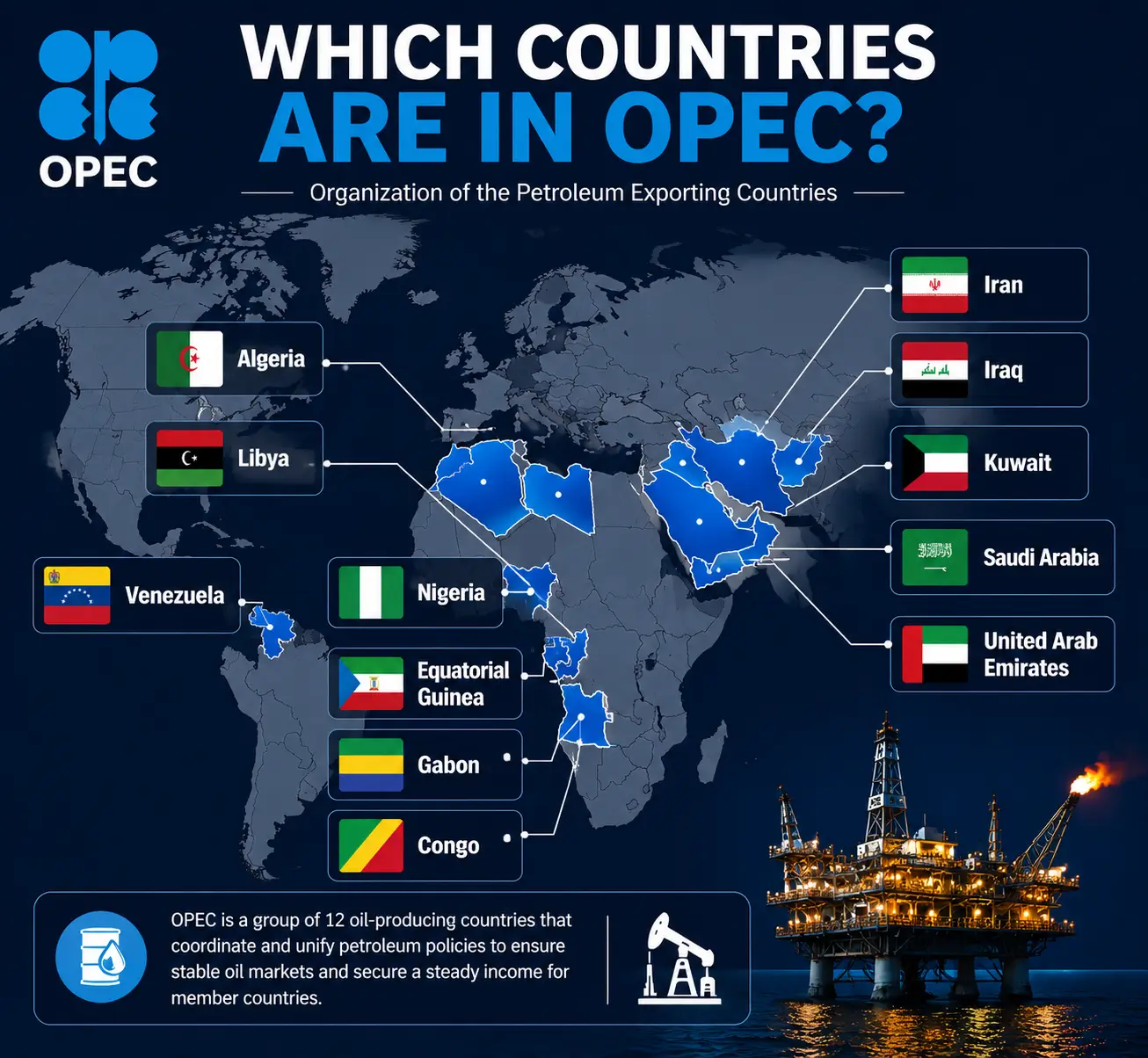
| Country | Region | Notes |
| Algeria | Africa | Joined in 1969 |
| Congo | Africa | Joined in 2018 |
| Equatorial Guinea | Africa | Joined in 2017 |
| Gabon | Africa | Joined in 1975, left in 1995, rejoined in 2016 |
| Iran | Middle East | Founding member |
| Iraq | Middle East | Founding member |
| Kuwait | Middle East | Founding member |
| Libya | Africa | Joined in 1962 |
| Nigeria | Africa | Joined in 1971 |
| Saudi Arabia | Middle East | Founding member and highly influential producer |
| United Arab Emirates | Middle East | Listed by OPEC’s official page as of the May 21, 2026 source check, but recent 2026 reporting has raised questions about its status |
| Venezuela | South America | Founding member |
This list also shows something people sometimes miss, OPEC is not only a Middle Eastern organisation. Several members are in Africa, one is in South America, and the group’s founding story includes both Middle Eastern and Latin American producers. The Middle East is central to OPEC because of reserves, production, and spare capacity, but it is not the whole organisation.
Founder members and full members
OPEC’s founding members are Iran, Iraq, Kuwait, Saudi Arabia, and Venezuela. They created the organization at the Baghdad Conference in September 1960. Other countries later joined as full members after their applications were accepted under OPEC’s rules.
The distinction matters because OPEC is not an open mailing list where any oil producer can simply appear. Membership reflects oil-exporting status, shared interests with existing members, and approval within the organisation. A country may be a major oil producer and still not be an OPEC member. The United States is the easiest example.
Former members
Several countries have left, suspended, or changed their relationship with OPEC. Qatar terminated its membership in January 2019. Ecuador withdrew effective January 1, 2020. Angola withdrew effective January 1, 2024. Indonesia has had a more complicated history, with suspension, reactivation, and another suspension.
Why would a country leave? Sometimes the answer is strategy. A country may want more freedom to raise production. It may decide that OPEC membership no longer fits its energy policy. It may be more focused on gas than oil, or on attracting investment, or on monetising reserves before long-term oil demand weakens. There is rarely just one reason.
Why Was OPEC Created?
OPEC was created in 1960 because oil-exporting countries wanted more control over the value of their own natural resources. Before OPEC, much of the international oil business was dominated by large Western oil companies. These companies had enormous influence over production, pricing, and concessions in oil-producing regions.
For producing countries, that arrangement became increasingly frustrating. Oil was not just another commodity sitting underground. It was the foundation of national revenue, development plans, and political sovereignty. If the price of oil was set in ways that exporting countries saw as unfair, their budgets and long-term development could be damaged.
The Baghdad Conference brought together Iran, Iraq, Kuwait, Saudi Arabia, and Venezuela. These countries had different political systems and different regional priorities, but they shared a basic concern: they wanted a stronger collective voice in the oil market. OPEC gave them that forum.
In its early years, OPEC did not instantly dominate oil markets. Influence grew over time. The 1970s, especially the 1973 to 1974 oil shock, showed the world that producer countries could have a major effect on supply, prices, and global economic policy. After that, OPEC was no longer a technical institution known mostly to energy insiders. It became a central actor in global economics.
What Is The Purpose Of OPEC?
OPEC’s stated purpose is to coordinate and unify petroleum policies among member countries. In practice, that means the organization tries to support stable oil markets, secure fair income for producers, and ensure petroleum supply to consumers. Those goals can sound harmonious on paper, but in the real world they often involve trade-offs.
Oil producers usually prefer prices high enough to support national budgets and investment in future production. Consumers, including households and businesses, usually prefer lower energy prices. Importing countries worry that high oil prices can feed inflation, weaken growth, or pressure trade balances. OPEC sits in the middle of that tension, which is why it helps to understand the main factors that affect crude oil prices.
Price stability
Price stability does not necessarily mean low prices. It means avoiding extreme swings that damage both producers and consumers. If prices collapse, oil-exporting countries may face budget crises and companies may cut investment in future supply. If prices spike too high, consumers suffer, inflation rises, and demand may eventually weaken.
OPEC tries to manage this problem by coordinating production policy. If the market appears oversupplied, members may agree to cut output targets. If the market appears too tight, they may increase targets. Of course, the market does not always obey the plan. Demand can surprise. Geopolitics can interrupt supply. Non-OPEC producers can increase output.
Producer income
Many OPEC members rely heavily on oil revenue to fund government spending. That can include public salaries, infrastructure, subsidies, education, health services, and national investment programs. When oil prices fall sharply, the pressure on these budgets can be immediate.
This is why OPEC decisions are not only technical market decisions. They are also fiscal decisions. A minister at an OPEC meeting is not thinking only about barrels per day. They are also thinking about domestic budgets, debt, foreign reserves, employment, and political expectations at home.
Regular supply
OPEC’s official purpose also includes maintaining a regular supply of petroleum to consuming nations. That part is sometimes overlooked because critics focus on production cuts and price support. But reliable supply matters to producers too. If consuming countries see oil exporters as unreliable, they have more reason to accelerate the adoption of alternatives, build strategic reserves, or support non-OPEC supply.
There is a quiet discipline in that. OPEC members benefit from revenue, but they also need customers. Push too hard, and consumers adapt.
OPEC vs OPEC+: What Is The Difference?
OPEC and OPEC+ are related, but they are not the same thing. OPEC is the formal organization of member countries. OPEC+ is a broader cooperation framework that includes OPEC members plus several non-OPEC oil-producing countries.
The most important non-OPEC partner in OPEC+ is Russia. OPEC+ became especially important after late 2016, when OPEC and non-OPEC producers began coordinating production decisions more closely. This expanded the reach of supply management because OPEC alone did not include every major producer capable of affecting global balances.
| Feature | OPEC | OPEC+ |
| What it is | Formal intergovernmental organisation | Cooperation framework between OPEC and non-OPEC producers |
| Core participants | OPEC member countries | OPEC members plus non-OPEC partners, including Russia |
| Main purpose | Coordinate member petroleum policies | Coordinate broader production actions across more producers |
| Legal identity | Formal organisation with statute and headquarters | Policy cooperation arrangement, not a single organisation in the same way |
| Market role | Influences supply through OPEC members | Can have wider supply influence because it includes more producers |
This distinction helps clear up a lot of confusion. Russia is central to OPEC+ discussions, but Russia is not an OPEC member. A country can cooperate with OPEC on production policy without being a member of OPEC itself.
For market watchers, OPEC+ often matters more than OPEC alone because crude prices respond to total expected supply. If OPEC members cut while non-OPEC partners increase output, the market interprets it differently from a coordinated OPEC+ cut. The market cares about the combined effect, not just the label on the meeting.
How OPEC Influences Oil Prices
OPEC influences oil prices mainly through production policy and market expectations. It does not usually set a fixed price for crude oil. Instead, it signals whether members intend to increase, reduce, or maintain output. Traders then compare that policy with demand forecasts, inventories, geopolitical risks, and non-OPEC supply. For a market view, traders often pair this kind of policy context with a live crude oil chart.
Think of it this way. If the world expects oil demand to be 102 million barrels per day and supply is likely to exceed that, prices may weaken. If OPEC or OPEC+ announces credible production cuts, traders may expect the oversupply to shrink. Prices can rise even before the cuts fully show up in shipping data because markets move on expectations.
OPEC meeting calendar
An OPEC meeting is one of the main scheduled events during which member countries review oil demand, supply conditions, production targets, voluntary cuts, and compliance. The market often reacts not only to the final decision, but also to what ministers signal about future output. If you are following crude oil, inflation, or energy-sensitive currencies, an economic calendar can help you track OPEC meetings alongside related data releases and central bank events.
Production quotas
A quota is a production target or limit. OPEC and OPEC+ use quotas to guide how much oil member countries should produce. The goal is to prevent too much supply from pushing prices down or too little supply from creating a damaging shortage.
Quotas are simple to describe and difficult to enforce. Countries have different budget needs, production capacities, field conditions, and political pressures. A member with urgent revenue needs may want to produce more. Another member with spare capacity may be able to cut output more easily. That is why headline quota announcements should be read alongside compliance data.
Voluntary cuts
Sometimes members announce voluntary cuts, meaning a country or group agrees to reduce output beyond its formal target. These cuts can be powerful market signals if traders believe they will actually happen.
But voluntary cuts also invite questions. How long will they last? Will all producers comply? Are the cuts from actual production or from a baseline that was already above real output? These details matter. A cut that sounds large in a headline may be less dramatic once analysts compare it with actual production.
Spare capacity
Spare capacity means the ability to increase oil production quickly if needed. This is one of the most important concepts in OPEC analysis. A country with large spare capacity has more practical influence because it can add supply during a shortage or remove supply during a weak market.
Saudi Arabia is often seen as OPEC’s most influential member partly because of this. It is not only a large producer. It has historically had more ability than many other countries to adjust output meaningfully. That gives it a special role in market expectations.
Compliance
Compliance means how closely countries follow agreed production targets. If OPEC announces cuts but members keep producing above their targets, the market may discount the announcement. If compliance is strong, the same announcement may have more force.
This is where OPEC becomes less like a neat economics textbook and more like a room full of governments with different needs. Every country wants the group to support prices. Not every country wants to sacrifice its own barrels to get there. That tension never really goes away.
OPEC Countries, Top Oil Producers, And Oil Reserves
OPEC membership, oil production, oil reserves, and oil exports are related, but they are not the same thing. This is one of the easiest places for readers to get tangled.
A country can have huge oil reserves but produce less than another country. A country can produce a lot of oil but consume much of it domestically, leaving less for export. A country can be a major producer without being an OPEC member. And a country can be an OPEC member but not one of the world’s top producers in a given year.
| Question | What it means | Why it matters |
| Which countries are in OPEC? | Formal membership in the organization | Shows who participates in OPEC governance and official policy |
| Which countries produce the most oil? | Current flow of crude or petroleum liquids output | Shows actual supply entering the market |
| Which countries have the most oil reserves? | Estimated recoverable oil still underground | Shows resource base, not current output |
| Which countries export the most oil? | Oil sold to foreign buyers | Shows influence on global trade and importers |
The United States is a good example of the distinction. It is often among the world’s largest oil producers, but it is not an OPEC member. Russia is a major producer and a key OPEC+ partner, but it is not an OPEC member either. Saudi Arabia, by contrast, is both an OPEC member and one of the most important oil producers and exporters.
Oil reserves can also mislead if taken alone. Venezuela has enormous proven oil reserves, but production has been constrained by years of investment, infrastructure, sanctions, and political challenges. A reserve number tells you what may be underground. It does not tell you what will reach the market next month.
For practical analysis, keep the categories separate. If you are asking about OPEC power, look at membership, production, spare capacity, and compliance. If you are asking about long-term resource wealth, look at reserves. If you are asking about trade exposure, look at exports.
Who Controls OPEC?
No single country formally controls OPEC. The organization has a conference of member countries, a secretariat, and rules for membership and decision-making. OPEC decisions are collective, and member states remain sovereign.
That said, influence is not distributed equally. Saudi Arabia is widely viewed as the most influential OPEC member because of its production scale, export role, and spare capacity. If Saudi Arabia signals a willingness to cut or raise output, markets pay attention. If a smaller producer makes the same signal, the price effect may be much more limited.
This does not mean Saudi Arabia can simply command the organization. Other members have their own budgets, political needs, production realities, and diplomatic priorities. Iraq, the UAE, Nigeria, Iran, Venezuela, and others may not all want the same output policy at the same time. That is why OPEC meetings can be tense even when the public statement sounds calm.
Is OPEC In Trouble?
OPEC is not disappearing, but it is under pressure. That is the balanced answer. The organization still matters because its members control large oil resources and because OPEC+ decisions can move market expectations. But its ability to shape the market is more contested than it was in earlier decades.
Several forces are working against easy coordination. Some members want higher production to fund domestic budgets. Some have limited capacity and cannot easily raise output even when quotas allow it. Non-OPEC producers, especially the United States, have changed the supply landscape. Energy transition policies also raise long-term questions about oil demand.
Internal tension
OPEC members do not all have the same economic profile. Some have large reserves and relatively low production costs. Others need higher prices to balance public budgets. Some can tolerate cuts for longer. Others need immediate revenue.
This creates a classic coordination problem. Everyone may prefer a stronger oil price, but each member has an incentive to sell more if it thinks others will cut. That is why compliance and trust matter.
Non-OPEC supply
The rise of US shale production changed OPEC’s operating environment. When OPEC restrains supply and prices rise, non-OPEC producers may respond by drilling more. That can limit OPEC’s influence over time.
This does not make OPEC powerless. It means OPEC decisions now operate inside a broader supply system. Oil is global. One group’s cuts are only part of the balance.
Energy transition
Long-term demand is another pressure. Electric vehicles, renewable energy, efficiency policies, and climate targets all affect expectations for future oil consumption. Oil demand has not vanished, and in many sectors oil remains hard to replace. But producers know that the future may not look like the past.
This can create an interesting tension. Some producers may want to monetize reserves while demand is still strong. Others may prefer to protect prices by limiting output. Those strategies do not always fit neatly together.
Geopolitics
OPEC also operates in a world of sanctions, wars, shipping risks, regional rivalries, and diplomatic pressure from major consuming countries. A disruption in the Strait of Hormuz, sanctions on a major exporter, or a conflict affecting oil infrastructure can change the market faster than any scheduled meeting.
So, is OPEC in trouble? It is better to say OPEC is being tested. Its influence is real, but more conditional than many casual descriptions suggest.

How OPEC Decisions Affect Consumers, Inflation And Markets
OPEC decisions can affect everyday life because crude oil is a basic input into fuel and transport. When crude prices rise, gasoline, diesel, jet fuel, shipping costs, and petrochemical inputs can become more expensive. The effect is not always immediate or equal across countries, but it can be meaningful.
Oil prices also feed into inflation. If energy costs rise quickly, headline inflation can increase. Central banks often look through short-term energy swings when setting policy, but persistent oil-price pressure can still shape inflation expectations. If businesses expect fuel and transport costs to stay high, they may raise prices. If workers face higher living costs, wage demands may also change.
For financial markets, OPEC matters because oil is both a commodity and a macroeconomic signal. A surprise production cut can lift crude prices, support energy shares, pressure oil-importing economies, and complicate inflation forecasts. A surprise production increase can push oil prices lower, ease some inflation pressure, and affect energy-company earnings.
Consumers and fuel prices
Consumers usually feel OPEC indirectly through fuel and energy costs. If crude oil rises, the price at the pump may eventually rise too, though taxes, refining margins, distribution costs, and local regulations also matter.
This is why OPEC news can become political. Higher fuel prices are visible. People may not follow petroleum policy, but they notice what it costs to fill a car, ship goods, or book a flight.
Inflation and central banks
Oil-price moves can influence consumer inflation data. Central banks care because energy affects household budgets and business costs. If oil prices rise during an already inflationary period, policymakers may be less comfortable cutting interest rates.
A one-month oil spike may not change policy. A sustained rise that feeds into broader prices can matter more. As usual in economics, context does the heavy lifting.
Traders and investors
Traders watch OPEC and OPEC+ meetings because markets often move on surprises. If the market expects no change and OPEC+ announces a deeper cut, crude prices may rise. If traders expect a cut and the group disappoints, prices may fall. A simple economic calendar can help readers track the wider macro events that often sit around energy-market volatility.
Investors also look at second-order effects. Energy companies may benefit from higher crude prices, while airlines, transport companies, and heavy energy users may face margin pressure. Oil-importing currencies can react differently from oil-exporting currencies. None of this is guaranteed, but it gives investors a framework for thinking through the news.
OPEC History Timeline
OPEC’s history is best understood as a long shift from resource sovereignty to market management, then to a more complicated era of OPEC+ coordination and energy-transition pressure.
- 1960: OPEC is founded at the Baghdad Conference by Iran, Iraq, Kuwait, Saudi Arabia, and Venezuela.
- 1960s: More producers join, and OPEC builds its institutional presence.
- 1965: OPEC’s headquarters move to Vienna, Austria.
- 1970s: OPEC’s influence becomes globally visible during major oil shocks and producer-country assertiveness.
- 1980s: Oil markets face volatility, changing demand, and pressure from non-OPEC supply.
- 1990s and 2000s: OPEC continues to manage production through periods of recession, war, and changing global demand.
- 2014 to 2016: A major oil-price downturn pushes OPEC to rethink coordination with non-OPEC producers.
- Late 2016 onward: OPEC+ becomes central as OPEC works with non-OPEC producers, especially Russia, on output policy.
- 2020: The Covid-19 demand collapse and Saudi-Russian price tensions show how fragile coordination can be under stress.
- 2020s: OPEC and OPEC+ face a more complicated market shaped by US shale, sanctions, war risk, energy transition, and internal production disputes.
This timeline helps explain why OPEC cannot be reduced to the 1970s oil embargo or to a single modern meeting. Its role has changed as the oil market has changed.
OPEC Map And Regional Breakdown
OPEC’s member countries are spread across the Middle East, Africa, and South America. That regional mix matters because members do not all face the same political risks, production costs, export routes, or fiscal pressures.
Middle East
The Middle Eastern members listed by OPEC’s official page include Iran, Iraq, Kuwait, Saudi Arabia, the United Arab Emirates, and, depending on the source-status issue discussed earlier, the UAE should be checked carefully before publication. This region contains some of the world’s most important oil reserves and export routes.
Saudi Arabia is especially important because of production scale and spare capacity. Iraq is also a major producer with recurring quota and revenue debates. Iran has major reserves and production potential, but sanctions and geopolitics complicate its market role.
Africa
African members listed by OPEC include Algeria, Congo, Equatorial Guinea, Gabon, Libya, and Nigeria. These countries have different production profiles and political realities. Libya’s production, for example, has often been affected by internal conflict. Nigeria has faced investment, security, and infrastructure challenges.
The African member group shows why OPEC policy is not one-size-fits-all. A production target may look simple in a table, but the practical ability to produce, export, or cut output varies from country to country.
South America
Venezuela is the key South American OPEC member and one of the organisation’s founding members. It has some of the world’s largest proven oil reserves, but its production has been shaped by years of economic, political, technical, and sanctions-related constraints.
This is a useful reminder that reserves are not the same as power. Oil in the ground matters, but market influence depends on whether it can be produced, transported, sold, and trusted by buyers.
Frequently Asked Questions About OPEC
What are the 12 countries in OPEC?
According to OPEC’s official member page published on May 21, 2026, the listed countries are Algeria, Congo, Equatorial Guinea, Gabon, Iran, Iraq, Kuwait, Libya, Nigeria, Saudi Arabia, the United Arab Emirates, and Venezuela. Treat this as source-dated because membership can change.
Who is the largest oil producer in OPEC?
Saudi Arabia is generally the largest and most influential OPEC producer. It is important not only because of output, but also because of spare capacity, export scale, and its central role in coordinating production decisions.
What is OPEC+?
OPEC+ is a broader producer-cooperation framework that includes OPEC members and non-OPEC oil producers. Russia is the most important non-OPEC partner. OPEC+ matters because it can coordinate supply policy across more of the global oil market than OPEC alone.
Who just quit OPEC?
Angola withdrew from OPEC effective January 1, 2024, according to OPEC’s official history page. In 2026, news reports also said the UAE planned to quit, but OPEC’s official member page, published on May 21, 2026, still listed the UAE.
Has Saudi Arabia left OPEC?
No. Saudi Arabia remains one of OPEC’s founding members and is widely considered the organization’s most influential producer. It plays a central role because of its production capacity, exports, and spare capacity.
Why does the United States produce so much oil but not belong to OPEC?
The United States is a major oil producer, but it is not an OPEC member because OPEC is a group of oil-exporting countries that coordinate petroleum policy through government membership. US oil production is driven largely by private companies operating in a different legal and market system.
Where does China get its oil?
China imports oil from many countries and regions, including the Middle East, Russia, Africa, and other suppliers. Its import mix changes over time based on price, contracts, sanctions, shipping routes, and geopolitical relationships.