



Oil prices extended gains on Tuesday after US President Donald Trump threatened further strikes against Iran following the first direct military exchange between the two countries in a month. Brent crude moved above $91 a barrel as renewed fighting revived concerns over Gulf energy infrastructure and shipping through the Strait of Hormuz.
Market Snapshot
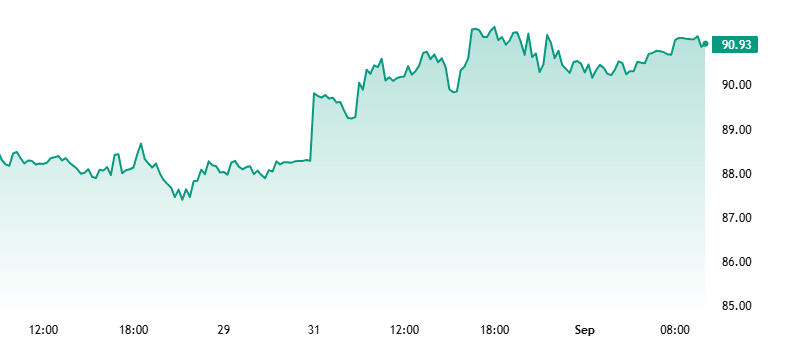
Brent crude futures rose 56 cents, or 0.6%, to $91.05 a barrel by 0044 GMT. US West Texas Intermediate crude gained 83 cents, or 1%, to $86.59.
The advance followed a sharp rally on Monday, when Brent settled 2.7% higher at $90.49 and WTI gained 2.8% to $85.76. Brent touched $91.52 during that session, its highest level since 25 August.
Oil markets had previously been focused on economic sanctions and diplomatic efforts surrounding Iran. The return of direct military action forced traders to restore part of the geopolitical supply premium that had faded during August.
US-Iran Fighting Resumes
US forces struck two Iranian rocket launchers on Larak Island in the Strait of Hormuz on Sunday after Washington said Revolutionary Guard forces appeared to be preparing rockets carrying sea mines.
Iran retaliated by launching ballistic missiles towards two US military bases in Jordan. Jordan said it intercepted eight missiles that entered its airspace, while reports indicated most of the weapons targeting US facilities were stopped.
Trump subsequently warned that Washington would respond strongly to the Iranian attack.
The exchange marked the first known direct military confrontation between the United States and Iran since late July, ending several weeks in which Washington had increasingly relied on economic sanctions rather than major military operations.
Hormuz Supply Risk Returns
The Strait of Hormuz remains the central concern for energy traders. The waterway handled nearly one-fifth of global crude oil and liquefied natural gas shipments before Iran restricted traffic after US and Israeli attacks began on 28 February.
Visible commodity vessel traffic through the strait fell to around five ships per day over the weekend. Actual traffic may be somewhat higher because some vessels have switched off tracking systems to reduce their exposure to attack.
Shipping risks increased further on Tuesday when a tanker leaving the strait reported being struck by three unidentified projectiles. No casualties or environmental damage were immediately reported.
Tim Waterer, chief market analyst at KCM, said renewed Iranian retaliation had brought the possibility of damage to Gulf energy infrastructure back into focus and added fresh uncertainty around Hormuz shipping.
Diplomacy Struggles to Gain Traction
Qatar and Oman have spent recent weeks attempting to broker arrangements that could restore safer commercial passage through Hormuz, but negotiations have produced limited progress.
Iran and Oman have discussed a framework covering management of the waterway and shipping revenues. Washington has resisted arrangements that could give Tehran greater control over international navigation.
The renewed fighting makes a near-term agreement more difficult. Any sustained disruption could affect exports from major producers including Saudi Arabia, Iraq, Kuwait, the United Arab Emirates and Qatar.
Analysts surveyed in August expect Brent to average about $85 a barrel during 2026, reflecting persistent supply disruptions despite weaker global demand.
Supply Buffers Remain Tight
The United States has fewer emergency barrels available than during earlier energy shocks. Crude inventories in the Strategic Petroleum Reserve fell by about 3.1 million barrels last week to 286.6 million barrels, their lowest level since November 1982.
Trump has said crude obtained through a newly announced US agreement involving Venezuela could eventually help replenish the reserve.
OPEC+ has meanwhile approved an additional production quota increase of about 188,000 barrels per day from September, completing the planned rollback of voluntary cuts introduced in 2023.
Those additional barrels may provide some supply relief, but their impact could be limited if Gulf shipping remains restricted. Russia’s extension of a diesel export ban until 30 September has added another constraint to refined fuel markets.
Outlook
Oil traders will watch whether Washington follows through on Trump’s threat of additional strikes and whether Iran responds with further attacks against US forces, tankers or Gulf energy infrastructure.
Shipping activity through the Strait of Hormuz will provide another key signal. A sustained recovery in vessel traffic could reduce the current risk premium, while further attacks could push crude prices higher.
Markets will also monitor diplomatic efforts by Qatar and Oman and the pace of US Strategic Petroleum Reserve drawdowns as traders assess how much spare supply is available if the conflict escalates again.