


Gold jumped more than 4% on Wednesday to its highest level in nearly seven weeks as hopes for progress on reopening the Strait of Hormuz pushed the dollar and US Treasury yields lower. Spot bullion climbed to $4,253.36 an ounce by 1815 GMT, its strongest daily advance since February.
Market Snapshot
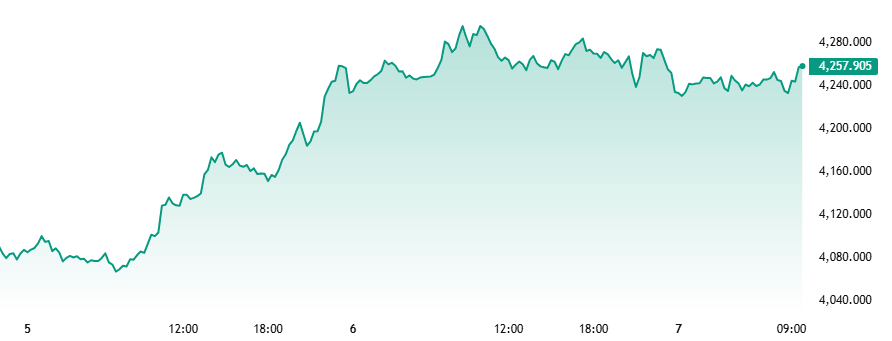
Spot gold (XAU/USD) rose 4.4% to $4,253.36 an ounce after touching $4,264.93, its highest since 18 June. The metal also moved above its 50-day moving average, around $4,160, adding technical momentum to the rally.
US gold futures for December delivery settled 3.7% higher at $4,305.20 an ounce. Silver gained 4.4% to $62.11, while platinum edged up to $1,740.04 and palladium advanced to $1,373.24.
The dollar traded near six-week lows against major currencies, while the US 10-year Treasury yield hovered near a one-week low. Both moves reduced pressure on non-yielding bullion.
Hormuz Talks Lift Sentiment
US President Donald Trump said Washington had held extensive discussions with Iran and described the negotiations positively, raising expectations that the five-month conflict could move towards de-escalation. Iran separately said it had reached an understanding with Oman on managing the Strait of Hormuz and that a joint announcement was being prepared.
The waterway carried roughly 20% of global oil and liquefied natural gas trade before the conflict. Restrictions on shipping have driven up crude prices, freight rates and insurance costs, feeding fears that higher energy costs could keep global inflation elevated.
Oil markets reflected the change in sentiment. Brent crude settled at $79.45 a barrel on Wednesday after falling 5% the previous day as traders assessed the possibility that tanker traffic could gradually return.
Rate Hike Expectations Ease
Lower oil prices reduced some concern that energy inflation would force the Federal Reserve to tighten policy more aggressively. Falling Treasury yields also improved the relative appeal of gold, which offers no interest return.
Independent metals trader Tai Wong said investors were returning as “the likelihood of rate hikes has fallen since last week”, while the weaker dollar and Iran pause also supported demand.
The change follows a period in which gold had struggled despite geopolitical tensions. Rising crude prices earlier in the conflict pushed inflation expectations and bond yields higher, creating a headwind for bullion even as investors sought traditional safe-haven assets.
Gold Recovers From Sharp Retreat
Wednesday’s rally marked a significant rebound, but gold remained about 24% below its January record of $5,594.82 an ounce and roughly 19% lower than when the Iran conflict began.
Underlying investment demand has also been uneven. Central-bank gold purchases during the first half of 2026 were the lowest since 2022, according to World Gold Council figures cited by Reuters. Gold-backed exchange-traded funds recorded net outflows of about 45 tonnes during the second quarter, when bullion posted its steepest quarterly decline since 2013.
JPMorgan said rate-sensitive ETF flows had become a more important marginal driver because central-bank purchases, Asian physical demand and retail interest had weakened. That could leave gold particularly sensitive to changes in US monetary policy expectations.
Deal Risks Remain
A lasting agreement over Hormuz is not assured. Iran has said it wants to retain a degree of authority over traffic through the strait, while Washington has opposed arrangements that would allow Tehran to control international shipping.
Price Futures Group analyst Phil Flynn described the potential agreement as fragile, noting that previous attempts at de-escalation had failed to hold.
Shipping risks also persisted elsewhere. Yemen’s Iran-aligned Houthis said they attacked a Saudi oil tanker near the export port of Yanbu, while disruptions to Black Sea and Caspian export routes added uncertainty to global energy flows.
Outlook
Gold traders will watch whether Iran and Oman formally announce their Hormuz arrangement and whether Washington accepts its terms. Actual tanker movements through the strait will provide a clearer test of whether geopolitical risks are genuinely easing.
Attention will also turn to Friday’s US non-farm payrolls report, Treasury yields and the dollar. Softer employment data could further reduce expectations for a September Fed rate increase, while stronger figures or renewed oil-price gains could limit gold’s recovery.