



Gold surged above $4,500 an ounce on Wednesday as a surprise US Treasury move to expand long-dated bond buybacks drove Treasury yields sharply lower and weakened the dollar. Spot bullion gained more than 4% during the session, reversing Tuesday’s decline and reaching its highest level since early June.
Market Snapshot
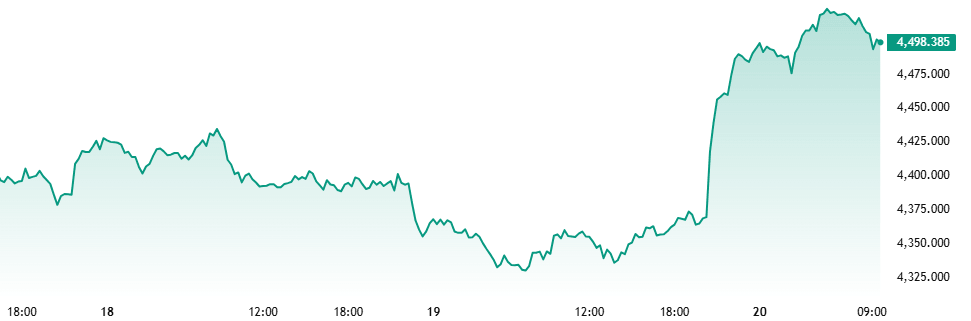
Spot gold (XAU/USD) rose 4.05% to $4,508.64 an ounce in late US trading, according to Reuters market data. Earlier, bullion had reached $4,499.20 by 1810 GMT, while US gold futures settled 2.8% higher at $4,545.30.
The advance pushed spot gold decisively above its 100-day moving average near $4,381 and extended a recovery from below $4,000 earlier in the northern summer. Precious metals rose broadly, with silver gaining nearly 4%, platinum climbing 5.1% and palladium advancing 2.7%.
The US Dollar Index (DXY) fell 0.84% to 98.80, while long-dated Treasury yields dropped by as much as 10 basis points. A weaker dollar makes gold cheaper for buyers using other currencies, while falling yields reduce the opportunity cost of holding non-interest-bearing bullion.
Treasury Move Drives Rally
The catalyst was an announcement from the US Treasury Department that it would double the size of liquidity-support buybacks for longer-dated nominal coupon securities to at least $4 billion per operation from $2 billion. The programme repurchases older, less-liquid government debt in an effort to improve trading conditions in the Treasury market.
The decision followed a sharp sell-off in long-term government bonds. The 30-year Treasury yield had approached 5.34% on Tuesday, around its highest level in nearly two decades, as investors demanded greater compensation for inflation, fiscal deficits and rising government debt.
“This was totally unexpected,” said Robert Gottlieb, an industry expert and former head of precious metals at Koch Supply and Trading, adding that lower long-term yields and a weaker dollar were strongly supportive for gold.
The Treasury began conducting buybacks in May 2024. While the programme does not represent Federal Reserve quantitative easing, Wednesday’s expansion signalled greater official attention to liquidity and volatility at the long end of the bond market.
Fed Minutes Temper Rate Outlook
Federal Reserve minutes released later on Wednesday showed policymakers remained concerned about persistent inflation. “Several” officials had been prepared to raise rates at the Fed’s 28 to 29 July meeting, while “many” said additional tightening could be required if inflation failed to move towards the central bank’s 2% target.
The Fed ultimately held its benchmark rate unchanged in July. Since that meeting, weaker employment figures and relatively benign inflation data have reduced expectations for an increase in September. Markets were pricing roughly a 31% chance of a September hike, with the probability rising to about 65% by December.
The combination matters for gold. Lower expected policy rates typically support bullion, but renewed inflation pressure could push yields higher again and challenge the latest rally.
Debt Concerns Add Broader Support
Wednesday’s reaction also highlighted growing investor sensitivity to US fiscal conditions. Long-term yields have risen sharply as markets assess heavier government borrowing, persistent deficits and the possibility that inflation remains above target for longer.
TD Securities said the Treasury announcement had given precious metals a renewed boost, adding that investor flows could strengthen if Treasury liquidity support combines with lower real interest rates and concerns about stagflation.
Gold can benefit when confidence in government bonds or currencies weakens because some investors use the metal as a store of value outside the conventional financial system.
Middle East Risks Remain
Geopolitical uncertainty continued to provide additional support. Oil settled near four-week highs as tensions with Iran remained elevated and shipping through the Strait of Hormuz stayed restricted. Brent crude rose to $91.42 a barrel, while US crude settled at $85.59.
Higher oil prices remain a risk for gold because another energy-driven inflation shock could lift Treasury yields and revive expectations for tighter Fed policy, partly offsetting safe-haven demand.
Outlook
Traders will watch whether US long-term yields continue to fall after the Treasury announcement, whether the dollar extends its decline and whether gold can hold above the $4,500 area.
Attention will also turn to incoming US labour and inflation data ahead of the Federal Reserve’s 15 to 16 September meeting. Developments in the Strait of Hormuz and oil prices remain another key variable because renewed energy inflation could quickly change both the Fed outlook and gold’s momentum.