


Gold slipped towards $4,050 an ounce in Asian trading on Tuesday, 28 July, surrendering part of the previous session’s gain. A pause in US-Iran attacks reduced immediate safe-haven demand, while investors avoided large positions before the Federal Reserve’s policy decision.
Market Snapshot
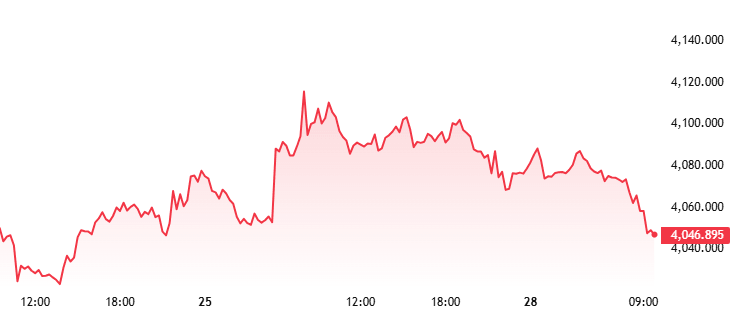
Spot gold (XAU/USD) traded around $4,050 per troy ounce during Asian hours. On Monday, bullion had risen 0.5% to $4,074.22 by 1745 GMT, while US gold futures for August delivery settled about 0.2% higher at $4,077.00.
The pullback came despite a sharp decline in oil prices and lower US Treasury yields. The benchmark 10-year Treasury yield fell to 4.649% on Monday, while the dollar softened slightly during the global session. Lower yields generally support non-yielding gold, but the easing of geopolitical risk reduced demand for defensive assets.
Silver rose 0.5% to $58.44 an ounce on Monday, while platinum gained 2% to $1,620.34 and palladium advanced 3.5% to $1,286.25.
Diplomatic Pause Changes Market Balance
Washington suspended its air campaign against Iran over the weekend after 13 consecutive nights of strikes. Tehran also said it would halt retaliatory attacks for as long as the US pause remained in place.
US President Donald Trump said on Monday that Washington and Tehran were holding “good talks”, but warned that military action could resume if negotiations failed. Iran said messages were continuing through mediators, although it denied reports that it had formally requested new negotiations.
The pause pushed Brent crude down 8.7% to $88.36 a barrel on Monday. US West Texas Intermediate crude fell 7.5% to $82.61, leaving both benchmarks at their lowest settlements in more than a week.
Lower energy prices reduce the risk that fuel and freight costs will drive another rise in inflation. That can benefit gold by reducing pressure for higher interest rates. However, diplomatic progress also weakens bullion’s attraction as protection against conflict, leaving the metal caught between opposing forces.
Fed Decision Takes Centre Stage
The Federal Open Market Committee began a two-day meeting on Tuesday and will announce its decision on Wednesday. The Fed has maintained its target range at 3.50% to 3.75% since the start of 2026.
Futures markets indicated a 62% probability that the central bank would leave rates unchanged, while traders assigned roughly an 82% chance to a rate increase by September. The uncertainty reflects softer recent inflation figures and concern that Middle East energy disruptions could renew price pressure.
“A hold is the most likely outcome, though a few dissenting votes in favour of a hike are possible,” Edward Jones senior analyst Brian Therien said in Monday commentary.
US consumer prices fell 0.4% in June, while annual inflation slowed to 3.5%. The Fed has nevertheless said inflation remains above its 2% objective, partly because of supply-related increases in energy and other sectors.
Oil Decline Offers Partial Support
Bart Melek, global head of commodity strategy at TD Securities, said oil’s decline from more than $100 towards $90 was pushing the interest-rate outlook lower. Falling rate expectations typically support gold because the metal offers no yield.
However, the physical energy market has not fully normalised. Fewer than 10 commodity vessels passed through the Strait of Hormuz each day over the weekend, with flows estimated at about 15% of pre-conflict levels. Shipping companies continue to face security, insurance and rerouting concerns.
This leaves markets vulnerable to renewed price volatility. Another exchange of strikes or further restrictions around Hormuz could quickly restore the geopolitical premium in both oil and gold.
Underlying Demand Remains Mixed
China’s net gold imports through Hong Kong more than doubled from a year earlier in June, although they declined by more than 5% from May. The figures indicate that Chinese buying remains supportive, particularly when prices approach the $4,000 level.
Demand in India has been weaker. Domestic dealers recently offered their largest discounts in seven weeks as high prices discouraged jewellery purchases, suggesting that physical buying may provide only limited support during short-term market declines.
Outlook
Traders will watch the Federal Reserve’s decision and Chair Kevin Warsh’s comments for guidance on whether a September rate increase remains likely. Thursday’s US Personal Consumption Expenditures report will provide another test of the inflation outlook.
Markets will also monitor the US-Iran negotiations, oil prices and tanker traffic through the Strait of Hormuz. A durable diplomatic agreement could reduce safe-haven demand, while renewed military action or a more cautious Fed message could drive investors back towards gold.