


Gold slipped below $4,400 an ounce in early Asian trading on Friday, 14 August, as investors took profits after bullion reached its highest level since early June. Spot gold (XAU/USD) fell 0.4% to $4,335.56 by 0049 GMT, even as softer US inflation data continued to reduce expectations for a Federal Reserve rate increase in September.
Market Snapshot
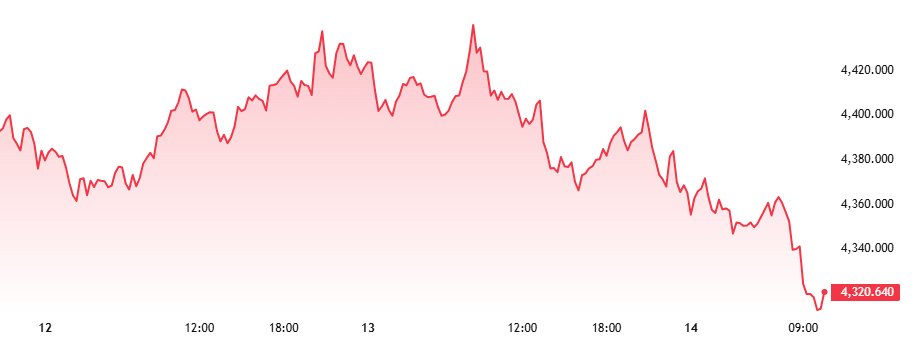
US gold futures fell 0.7% to $4,391.34 an ounce at the same point in early trade. Silver declined 0.6% to $64.09, while platinum slipped 0.5% to $1,710.58. The US Dollar Index was little changed near 99.90.
The pullback extended Thursday’s reversal. Spot gold had climbed as high as $4,449.39, its strongest level since 5 June, before falling 1.2% to $4,354.58 by 1658 GMT. US futures settled 1.1% lower at $4,420.40.
Bob Haberkorn, senior market strategist at StoneX, said “4,500 is a big resistance point for gold”, with the metal’s rapid advance encouraging traders to lock in gains near that level.
Inflation Data Ease Fed Pressure
The US Producer Price Index was unchanged in July, below economists’ expectations for a 0.2% increase. Services prices rose 0.2%, while goods prices fell 0.7%, helped by lower energy costs.
The data followed Wednesday’s Consumer Price Index, which rose 0.1% in July and 3.4% from a year earlier. Core inflation, excluding food and energy, increased 0.2% on the month and 2.5% annually.
Fed funds futures showed traders assigning about a 35% probability to a September rate increase, down from 55% a week earlier. The Fed kept its benchmark target at 3.50% to 3.75% in July, although three policymakers favoured an immediate increase.
Noel Dixon, senior macro strategist at State Street, said the inflation reports “help to make the case for the Fed staying on hold in September”.
Hormuz Standoff Keeps Risks Elevated
Geopolitical uncertainty remains a counterweight to the improving inflation outlook. Efforts to revive an interim US-Iran agreement have made little progress, while Tehran continues to demand sanctions relief and the release of frozen assets before fully reopening the Strait of Hormuz.
The United States said on Thursday that it could maintain its naval blockade of Iran indefinitely. The United Arab Emirates also said two vessels operated by state-owned ADNOC were attacked while transiting Hormuz, adding to concerns over the safety of commercial shipping.
Traffic through the strait fell to eight vessels on Tuesday, compared with roughly 130 to 140 ships a day before the war. The route carried about one-fifth of global oil and liquefied natural gas flows before fighting began in February.
Oil Adds Another Policy Variable
Despite the geopolitical risks, oil prices fell sharply on Thursday as traders focused on weaker global demand forecasts and a large increase in US crude inventories. Brent crude settled 2.1% lower at $87.07 a barrel, while West Texas Intermediate fell to $81.25.
Lower oil prices could reduce future inflation pressure, supporting expectations that the Fed can remain on hold. That is generally favourable for gold because lower interest rates reduce the opportunity cost of holding an asset that pays no yield.
However, renewed attacks around Hormuz or elsewhere in the region could quickly lift crude prices again, complicating both the inflation outlook and gold’s reaction to geopolitical risk.
Recent Rally Loses Momentum
Gold had gained roughly 9% in the week before Thursday’s reversal, supported by softer US economic data, a weaker dollar and renewed Chinese and retail demand. Independent analyst Tai Wong said the scale of the advance had encouraged profit-taking around important technical levels.
The broader August rally has also been supported by central-bank demand and concerns over geopolitical and fiscal uncertainty, although bullion remains well below its January record.
Outlook
Traders will watch whether gold can regain the $4,400 area and whether selling intensifies if prices move closer to $4,300. Attention will also focus on upcoming US employment and inflation figures, along with Fed Chair Kevin Warsh’s policy signals later in August.
Developments in the Strait of Hormuz remain the other major variable. Progress towards reopening the waterway could ease energy inflation risks but reduce safe-haven demand, while renewed shipping attacks could lift both oil-market uncertainty and demand for gold.