


Gold climbed to its highest level in more than three months on Tuesday as falling US Treasury yields, a weaker dollar and renewed trade tensions strengthened demand for bullion. Spot gold reached $4,696.18 an ounce before easing as traders took profits near the closely watched $4,700 level.
Market Snapshot
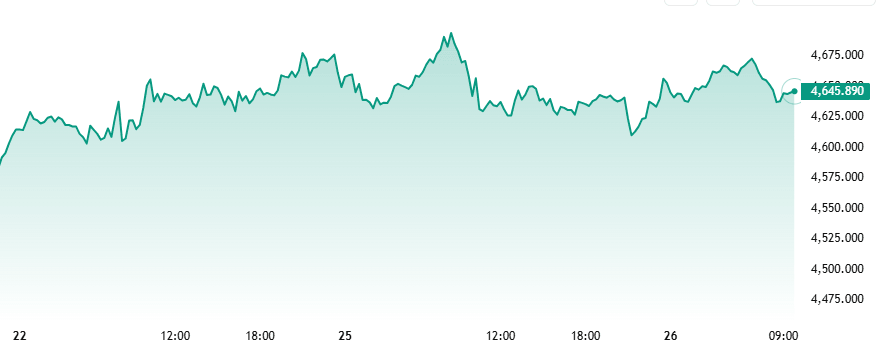
Spot gold (XAU/USD) was down 0.1% at $4,647.03 an ounce by 1816 GMT after touching its highest level since 14 May. US gold futures settled 0.1% lower at $4,694.50.
The intraday advance extended a rally that has pushed bullion through its 200-day moving average and erased much of its earlier decline. Gold gained more than 5% in the previous week as investors responded to lower bond yields, a softer dollar and renewed demand for alternatives to US financial assets.
Bart Melek, global head of commodity strategy at TD Securities, said the late-session retreat reflected fading momentum near a major technical barrier. “Gold moving to a strong resistance level at $4,700” encouraged some traders to take profits, he said.
Treasury Moves Pressure Dollar
Gold has drawn support from the US Treasury Department’s decision to increase liquidity-support buybacks of longer-dated government bonds. The Treasury doubled the maximum size of certain operations to $4 billion as officials sought to improve liquidity after long-term borrowing costs surged.
The move helped trigger a rally in Treasuries. US yields fell by as much as eight basis points on Tuesday, with the benchmark 10-year yield posting its largest decline in around two months.
The dollar also weakened, increasing the appeal of gold for buyers holding other currencies. Concerns that official efforts to contain long-term borrowing costs could undermine confidence in US assets have also encouraged what some investors describe as a debasement trade into gold and cryptocurrencies.
LPL Financial strategist Adam Turnquist said cleaner investor positioning, a softer dollar and improving investment demand were providing stronger fundamental support after gold’s earlier correction.
Trade Tensions Add Haven Demand
Renewed trade friction between the United States and Canada provided another source of uncertainty.
US tariffs of 50% on around $20 billion of Canadian goods have taken effect, while Canada has announced retaliatory measures. US President Donald Trump has also threatened to extend 50% duties to Canadian-built vehicles and automotive parts.
The dispute has raised questions about the stability of the broader United States-Mexico-Canada Agreement and the effect of prolonged tariffs on highly integrated North American manufacturing supply chains.
Gold often benefits when political or trade uncertainty increases because investors use the metal as a store of value outside conventional currency and government debt markets.
Oil Decline Eases Rate Concerns
Falling oil prices added support by reducing fears that energy costs would drive another increase in inflation.
Brent crude fell sharply on Tuesday amid reports of possible progress towards a US-Iran ceasefire and constructive talks between Iran and Oman over restoring safe navigation through the Strait of Hormuz.
Lower oil prices could ease transport and production costs and reduce pressure on the Federal Reserve to raise interest rates. Higher rates typically weigh on gold because bullion pays no interest.
Recent US inflation figures have already encouraged markets to reduce expectations for additional tightening. Traders were pricing about a 38% probability of a Fed rate increase in September.
Investment Demand Strengthens
Physical and investment demand also showed signs of improvement. China’s net gold imports through Hong Kong increased about 11% in July from the previous month as investment buying strengthened.
Gold’s technical picture has also improved. The metal has broken above the downward trend that followed its January record and reclaimed its 200-day moving average, encouraging momentum-driven investors to return.
However, the rapid rebound has brought prices close to resistance around $4,700, increasing the possibility of consolidation after the recent rally.
Outlook
Investors will focus on the US Personal Consumption Expenditures inflation report for July for further evidence on whether price pressures are easing. The figures could change expectations for the Federal Reserve’s September meeting and influence Treasury yields and the dollar.
Fed Chair Kevin Warsh’s Jackson Hole speech will be another major test for gold later in the week. Traders will also watch US-Canada trade tensions and developments surrounding Iran and the Strait of Hormuz, with either escalation capable of renewing demand for safe-haven assets.