



The Australian dollar strengthened against the US dollar on Wednesday as softer US labour market data and a weaker growth outlook reduced expectations for further Federal Reserve tightening. The AUD/USD pair traded at 0.7169 after reaching a daily low of 0.7121, gaining 0.35% as investors reassessed the path for US interest rates.
Market Snapshot
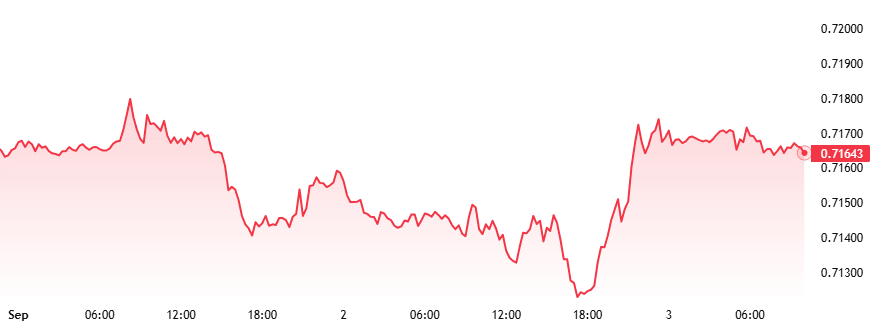
The Australian dollar extended its recovery as the US dollar weakened following a series of softer economic signals. AUD/USD moved higher after earlier pressure from broad dollar strength, with traders adjusting positions ahead of upcoming Australian business activity data.
The US Dollar Index remained under pressure as investors reduced expectations for additional rate increases from the Federal Reserve. A weaker outlook for US interest rates generally supports higher-yielding currencies such as the Australian dollar.
The move also reflected improved risk appetite across financial markets, with investors becoming more comfortable holding growth-sensitive currencies after recent concerns over global monetary policy.
US Economic Data Weighs On Dollar
The main catalyst for the Australian dollar’s advance was a shift in expectations for the Federal Reserve’s policy outlook following weaker US economic data.
Recent labour market figures pointed to slowing employment conditions, increasing concerns that higher interest rates may be weighing on the US economy. At the same time, revised US gross domestic product data showed economic activity remained resilient but did not fully remove concerns over slowing momentum.
The combination of softer employment signals and mixed growth data encouraged markets to reduce expectations for further Fed tightening.
Lower expectations for US interest rates tend to weaken the dollar by reducing the relative attractiveness of US assets. This provided support for currencies such as the Australian dollar, which typically benefits from improved global risk sentiment.
Australian Data In Focus
Attention is now turning towards Australia’s upcoming Purchasing Managers’ Index (PMI) data for further clues on domestic economic conditions.
The figures will provide insight into activity across manufacturing and services sectors and could influence expectations for the Reserve Bank of Australia’s next policy decisions.
The RBA has continued to monitor inflation and economic growth closely, with future decisions dependent on the balance between easing price pressures and maintaining economic stability.
A stronger PMI reading could reinforce confidence in the Australian economy and provide additional support for the currency. However, weaker activity data may increase expectations for further monetary easing.
Rate Differential Remains Key Driver
The interest-rate gap between Australia and the United States remains one of the most important drivers for AUD/USD.
The Australian dollar has faced pressure in recent months as markets focused on the possibility of higher-for-longer US interest rates. However, signs of cooling US economic conditions have shifted attention back towards the possibility of a more accommodative Federal Reserve stance.
The currency remains sensitive to changes in Treasury yields and expectations for the timing of future Fed moves.
Analysts said the Australian dollar’s near-term direction would depend on whether incoming US data continues to support a slower monetary tightening path.
Broader Market Factors
Despite the latest gains, the Australian dollar continues to face external risks, including global growth concerns and uncertainty surrounding trade conditions.
Australia’s close economic relationship with China also remains an important factor for the currency, although the immediate move was mainly driven by developments in US monetary policy expectations.
Commodity markets remain another long-term influence, as Australia is a major exporter of raw materials including iron ore and energy products. However, traders are currently focused more on central-bank policy signals and economic data releases.
Outlook
Traders will watch upcoming Australian PMI figures for signs of domestic economic strength and monitor further US labour and inflation data for clues on the Federal Reserve’s next move.
The AUD/USD pair will likely remain sensitive to changes in US Treasury yields and the dollar’s direction. Continued weakness in US economic data could provide further support for the Australian dollar, while stronger-than-expected figures may revive expectations of tighter Fed policy and limit gains.