



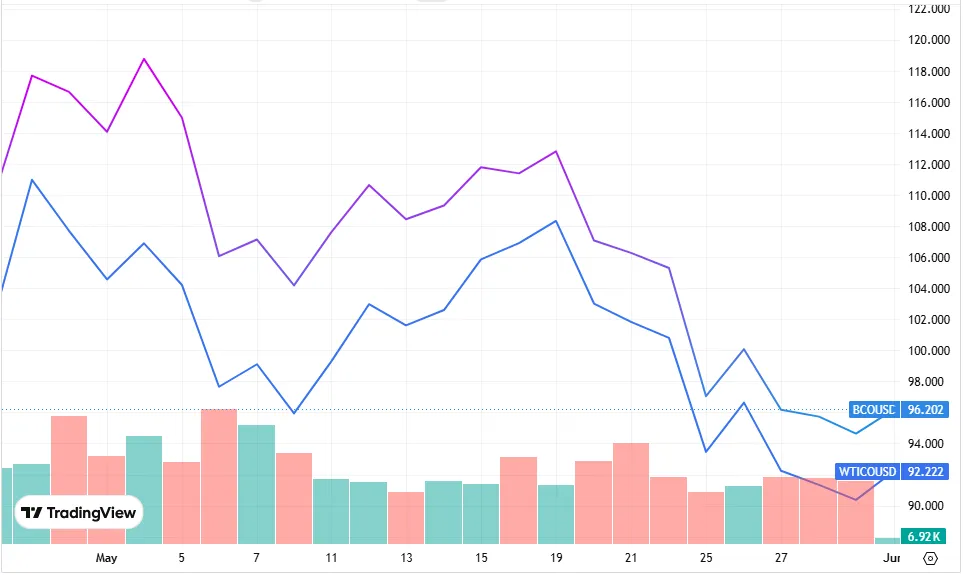
Oil prices rose more than 2% in early trade on Monday after Israel ordered troops to move further into Lebanon, reviving fears of wider Middle East conflict and potential supply disruption. U.S. crude futures were up 2.48% at $89.53 a barrel and Brent futures gained 2.12% to $93.05, according to Reuters.
Market snapshot
The move extended Friday’s gains, when Brent and WTI settled up 1.8% and 1.7% after hopes for a U.S.-Iran ceasefire extension lifted sentiment. Monday’s advance pushed a fresh risk premium back into crude as traders reassessed the durability of any diplomatic de-escalation in the region.
Analysts said the market remains sensitive to any sign that fighting could broaden beyond Lebanon and threaten flows from the wider Middle East. “The market is paying up for headline risk again,” one energy trader said, adding that crude had been vulnerable to sharp intraday swings as ceasefire expectations rose and fell.
Event details
Reuters reported that the stepped-up fighting came after the U.S. hosted Israeli-Lebanon peace talks in Washington on Friday, which had underpinned expectations that ceasefire-related calm could hold. Israel’s move into Lebanon, despite a ceasefire announced more than six weeks ago, quickly reversed some of the recent optimism.
The reaction was strongest in front-month crude, reflecting concern over near-term supply disruption rather than a broad deterioration in fundamentals. Brent’s rise back above $93 and WTI’s push toward $90 underscore how geopolitical headlines continue to dominate price action.
Cross-asset moves
A jump in oil typically supports energy shares while weighing on sectors sensitive to higher fuel costs, such as transport and airlines. In broader macro terms, a sustained crude rally can lift inflation expectations and complicate the policy outlook for central banks already balancing slowing growth against sticky prices.
Safe-haven demand usually also strengthens during such episodes, with the dollar, U.S. Treasuries and gold often drawing support if investors decide the escalation is likely to persist. One London-based oil strategist said the market is watching whether the latest fighting stays localized or turns into a wider regional shock that could disrupt shipping or production.
Macro implications
The immediate risk for markets is a renewed energy-led inflation impulse, especially if crude keeps rising from current levels. Higher oil prices can filter into transport, manufacturing and consumer costs, while also tightening financial conditions through expectations of slower rate cuts or a more cautious central bank stance.
For now, the move appears driven more by geopolitics than by a change in physical balances. Still, traders tend to price Middle East conflict quickly because even a limited disruption can have outsized effects on a market that depends on uninterrupted flows.
What traders watch
- Whether Israel’s operation in Lebanon broadens or stabilizes, which would shape the size of the risk premium.
- Any fresh U.S., Iranian or regional diplomatic comments on the ceasefire outlook.
- Follow-through in Brent and WTI, especially whether front-month contracts hold above $90 and $93 respectively.