


US stock index futures climbed early Wednesday, buoyed by tentative optimism that the Iran war may be nearing a political off‑ramp even as elevated oil prices and geopolitical risk keep the Federal Reserve on the sidelines. Benchmark futures on the Dow (YM), S&P 500 (ES) and Nasdaq‑100 (NQ) all pointed higher, while Brent crude (LCOc1) held above 100 dollars a barrel, underscoring renewed inflation‑policy tension.
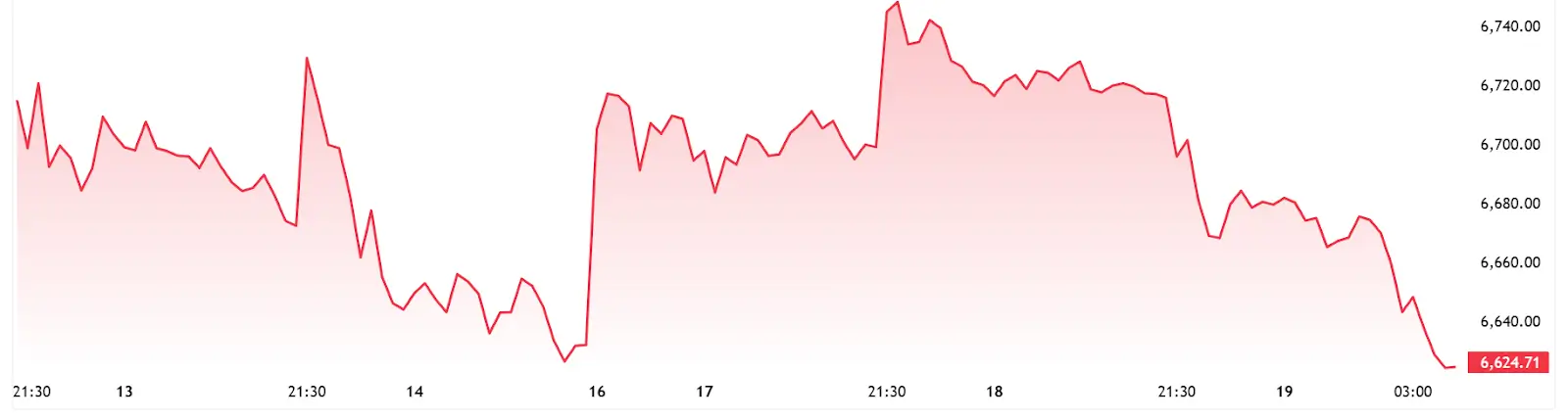
Market snapshot
By 07:50 ET (11:50 GMT), E‑mini Dow futures (YM) had risen 159 points, or 0.3%, to around 52,600; S&P 500 futures (ES) gained 23 points, or 0.3%, to roughly 6,950; and Nasdaq‑100 futures (NQ) advanced 116 points, or 0.5%, near 24,400. The move followed a positive session on Wall Street the prior day, with megacap tech and semiconductors leading the advance, as traders balanced Middle East risk against hopes for a de‑escalation.
Risk‑on and risk‑off flows
Equity gains were concentrated in growth‑oriented names, with Nasdaq futures outperforming the Dow, reflecting above‑average positioning in artificial‑intelligence‑linked tech and semiconductors. Within that group, Micron (MU) loomed as a key volatility driver after the memory‑chip maker guided to an adjusted profit of about 8.42 dollars a share in the fiscal second quarter, nearly double the consensus estimate, amid tight supply of high‑end data‑center memory. Safe‑haven demand, however, remained elevated: gold (XAU/USD) and Treasuries held modest gains, even as stocks rose, underscoring that investors are still pricing in a higher probability of prolonged conflict than traders were a month ago.
Oil and inflation dynamics
Brent crude gained 1.3% to 104.76 dollars a barrel, despite a brief pullback in Asian trading after Iraq and Kurdish authorities agreed to resume oil exports through Turkey’s Ceyhan port. Prices remain well above pre‑war levels, pushing US gasoline costs to their highest since October 2023 and feeding through into headline inflation, which is already sensitive ahead of the November midterm elections. Analysts at Goldman Sachs, including David Mericle, noted that “the start of the war in Iran and the spike in oil prices” are now the most important developments for the Federal Open Market Committee, raising the risk that a higher inflation path could delay rate cuts.
Fed policy and macro implications
The Fed is widely expected to hold its benchmark federal funds rate in a 3.5% to 3.75% band at the conclusion of its two‑day meeting, with policymakers explicitly weighing the Iran conflict’s upside inflation risk against signs of labor‑market softening. In a note, Goldman said the war heightens both the risk of an earlier need to ease in response to a weaker labor market and the risk that elevated energy prices prolong above‑target inflation, effectively tightening the Fed’s options. “This is a classic ‘risk on both sides of the dual mandate’ scenario,” said one New York‑based macro strategist, echoing the tone of recent Fed‑watch research.