


Crude oil prices tumbled sharply on Monday, with benchmark Brent crude sliding well below 100 dollars a barrel as fresh optimism around a US‑Iran peace framework revived expectations of a gradual reopening of the Strait of Hormuz and a drawdown of the current Middle East risk premium.
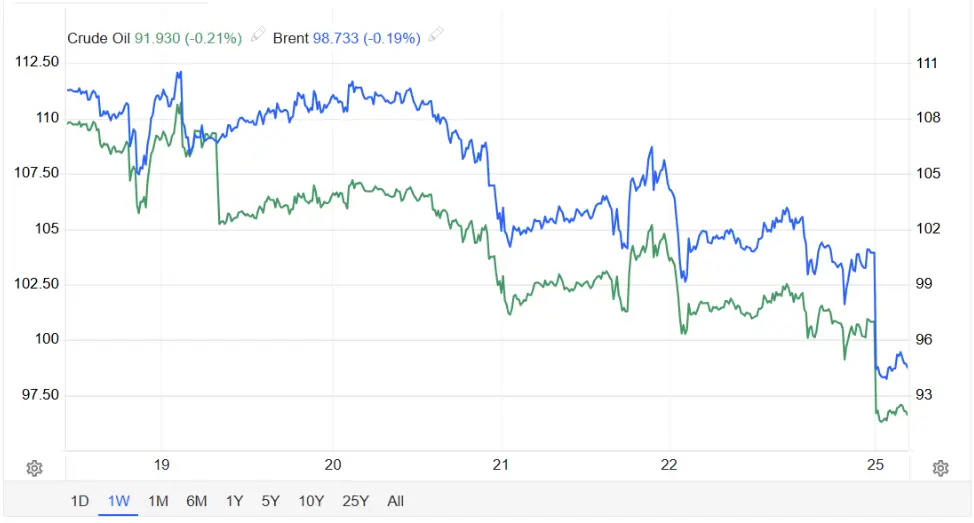
Front‑month Brent (BRENT) futures fell over 5% intraday to around 98.12 dollars a barrel, while West Texas Intermediate (WTI) crude shed about 5.2% to roughly 91.31 dollars, marking the largest one‑day drop in a week and underscoring how diplomacy is now the dominant price driver.
Event details
The selloff followed new indications that Washington and Tehran are moving toward a limited, temporary agreement that would halt direct hostilities while leaving core disagreements unresolved.
Reports from several Middle‑East‑focused outlets suggest a draft memorandum would allow a phased easing of the US blockade on Iranian vessels and a gradual restoration of normal tanker traffic through the Strait of Hormuz, with Iranian enriched‑uranium stockpiles to be transferred to a third‑country custodian as part of a broader confidence‑building package.
President Donald Trump has repeatedly signaled that talks are in “final stages,” saying any deal must be reciprocal and would only be implemented if Iran ceases its blockade of the Strait; in comments over the weekend he added that a breakdown or a return to air strikes could push crude sharply back above 120 dollars.
Trading reaction
The immediate reaction was a broad‑based sell‑off in front‑month contracts, with intra‑session ranges spanning from modest gains to more than 5% losses as headlines on potential progress and diplomatic skepticism alternated.
Brent at one point traded in a band of roughly 97.30 to 102.6 dollars, while WTI oscillated between about 91.3 and 97 dollars, reflecting the market’s struggle to price the probability of a deal versus the risk of renewed military escalation.
Tanker‑rate and war‑risk‑premium indicators in the Gulf have softened, with spot freight assessments for Aframaxes and VLCCs off low‑grade, but brokers caution that charterers are still demanding higher insurance riders and route‑alternative planning in case the Strait remains constrained.
Analyst and trader views
“Prices are pricing in an 80‑90 dollar world if the Strait fully reopens and Iranian exports ramp up, but that’s not a given,” said a senior crude strategist at a major European bank, who noted that the tentative memorandum does not yet lay out a detailed timetable for sanctions relief or port access.
“The market is still one tweet or missile strike away from a spike back above 110, so the downside is capped until there is physical evidence of more barrels moving freely,” a New York‑based hedge‑fund trader added.