


Oil prices surged more than 13% at the Asian open on Monday, with Brent crude hitting $82 a barrel, as US and Israeli strikes that killed Iran’s Supreme Leader Ayatollah Khamenei sparked retaliation, including attacks on tankers in the Strait of Hormuz, the vital artery for 20% of global oil consumption.
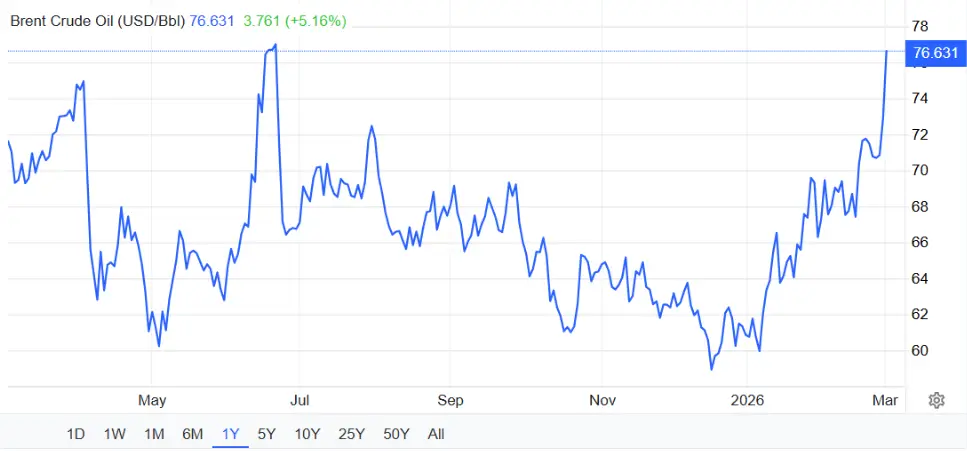
Brent futures opened 13% higher before easing slightly to $81.50, up 11%, while US West Texas Intermediate crude climbed 12% to $77.80. The rally priced in a sharply elevated risk premium amid fears of prolonged supply disruptions from the world’s most critical oil shipping chokepoint.
The US and Israel unleashed a barrage of strikes over the weekend against Iran, killing hundreds, including Khamenei and several top officials, according to reports. Iran hit back with missile barrages at Israel and US-allied bases in Bahrain, Kuwait, Qatar and the United Arab Emirates, while Revolutionary Guard forces targeted ships transiting the Strait of Hormuz.
“With the retaliatory action now evolving to attacks on oil tankers in the Strait of Hormuz, the threat on oil supplies has substantially risen,” ANZ analysts wrote in a note, highlighting the waterway’s role in ferrying roughly 20% of world oil demand, or up to 15-20 million barrels per day.
OPEC+ hikes output modestly
OPEC and allies convened an emergency meeting on Sunday, agreeing to boost production by 206,000 barrels per day from March, a fraction of the potential at-risk volumes if Hormuz flows are curtailed. Saudi Arabia and the UAE hold over 3 million bpd of spare capacity, but rerouting Gulf crude would spike shipping costs and delay deliveries to Asia.
US President Donald Trump warned late Sunday that military operations would continue, with more American casualties likely, cementing perceptions of an open-ended conflict rather than a limited exchange.
Broader risk-off cascade
The oil shock rippled through markets, hammering equity futures: S&P 500 E-minis fell 1.8%, Nasdaq futures dropped 2.1%, while Europe’s Stoxx 600 futures shed 1.5%. Safe-haven gold rose 2.2% toward $2,700 an ounce, and 10-year US Treasury yields dipped 5 basis points to 4.15%.
The dollar index strengthened 0.4%, buoying energy importers but pressuring exporters. Airline and consumer discretionary shares led losses in pre-market trading, as traders flagged risks of higher fuel costs reigniting inflation.
Inflation and growth threats mount
A sustained Brent rally toward $90-$100/bbl could add 0.5-1 percentage point to global headline inflation via pass-throughs in transport and refining, complicating rate-cut paths for the Federal Reserve and other central banks. Energy-sensitive economies like Japan, India and Europe face the sharpest squeeze, with real incomes at risk amid still-fragile post-pandemic recoveries.
Key monitors this week include Hormuz tanker traffic volumes via satellite tracking, updates on Iranian export terminal status, and signals from OPEC+ heavyweights on further output unlocks. Options markets now price in a 70% chance that Brent will top $90 by end-March if disruptions persist.